Resources & FAQ
Resources
Click on each resource below to learn more and download the PDFs.
In-betweens were created as a follow-up to our racial equity trainings. Participants of our introductory training asked for ways to continue practicing our shared language developed from the intro training. So we started meeting monthly to have a group reading and discussion session as a way to create a community of learners and practitioners working towards racial equity.
This guide is designed as a “grab and go”, for you to pick up and use with your own crew of practitioners or as a template to create your own guide based on resources and learning styles most relevant to you, your community and your region.
“Building Equity in the NC Food System Through Community Practice” is a document authored by Christopher J. Gillespie, PhD, who was a CORE Fellow. The document addresses challenges and opportunities within the North Carolina (NC) food system, emphasizing the need for strategic partnerships and community-driven initiatives.
In-Betweens were developed as a follow-up to our racial equity trainings. Participants of our introductory training asked for ways to continue practicing our shared language developed from the intro training and deepen our collective analysis. We meet monthly to have a group reading and discussion session, featuring readings, video clips and other “story prompts” that intersect food and race, as a way to create a community of learners and practitioners working towards racial equity.
This guide is designed as a “grab and go”, for you to pick up and use with your own crew of practitioners or as a template to create your own guide based on resources and learning styles most relevant to you, your community and your region.
Because of COVID-19, most of our In-Betweens in 2020 took place virtually. This guide includes summaries and resources from each of the 2020 In-Betweens.
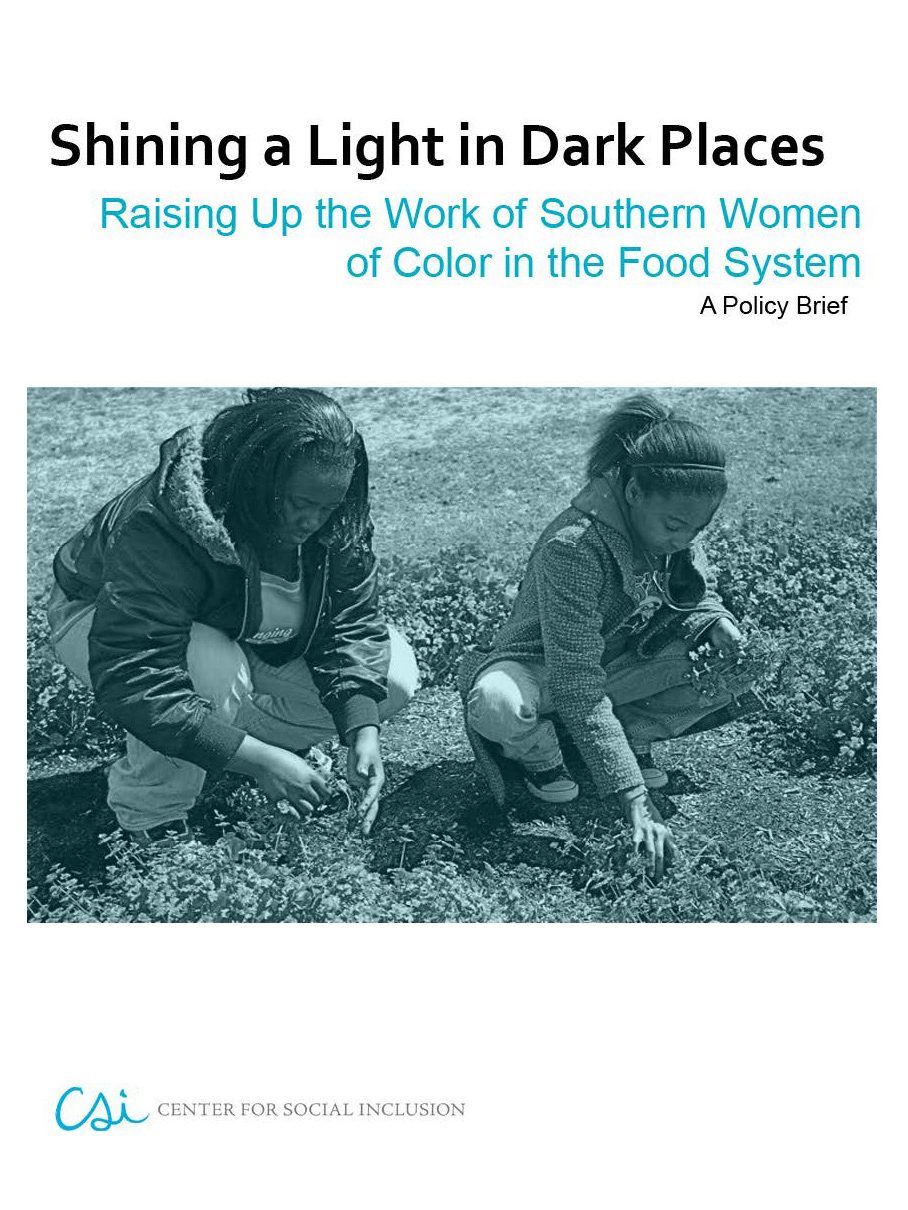
In this report from the Center for Social Inclusion (CSI), CEFS Community Food Systems Outreach Coordinator and 2013 CSI Food Equity Fellow Shorlette Ammons describes the realities of current and past food systems from the perspectives of Southern women of color. Shorlette argues that we can achieve equitable food systems change by 1) changing the narrative; 2) identifying food systems policy that directly affects women and children; 3) developing women of color leadership to lead the policy change; 4) building capacity and developing organizations; and 5) finding ways to sustain family farms.
Frequently Asked Questions
No. We offer Racial Equity in the Food System: Level 1 and Level 2. These are both 2-day workshops that are free to the community. We encourage organizations to support community-based contractors that are doing amazing work in the food system.
Level 1 is our introductory offering. The purpose of Level 1 is to build shared language, a shared analysis, and a shared vision on how we can embody and apply equitable practices in our lives and institutions. Anyone working within the food system may register for one of these learning opportunities held throughout the year.
Level 2 is open to individuals who have completed an introductory Level 1-style or anti-racism learning opportunity. Participants are required to complete the CORE Level 1 or a similar learning opportunity prior to registering for Level 2. The purpose of Level 2 is to take our analysis from Level 1 and broaden our reflective strategy, supporting individuals and organizations to practice the application of racial equity policy and principles.
To be in community and build culture, it is necessary to gather and practice, especially when the existing culture encourages divisions among groups of people that could work beautifully together to accomplish similar goals. A Community of Practice is the process of bringing people together to form new norms that encourage equitable policy making and practices.
We practice implementing equitable competencies in all of our gatherings, including our team meetings
For all general questions or inquiries related to CORE programs or events – please email us at core@upstreamworks.org. Please be advised, all emails will be responded to within 3-7 business days.
Sign up for our newsletter to learn about new projects, programming, and ways to engage with our community. Visit our Contact Us page to sign up.